Composition
What is it made from? Cotton, polyester, nylon and elastane are fibres. A blend states how much of each is present.
Example: 88% polyester / 12% elastane
FROM FIRST IDEA TO YOUR NEXT COLLECTION
For the team kit you’re planning. The clothing brand you’re building. Understand the materials and decisions that shape your garment.
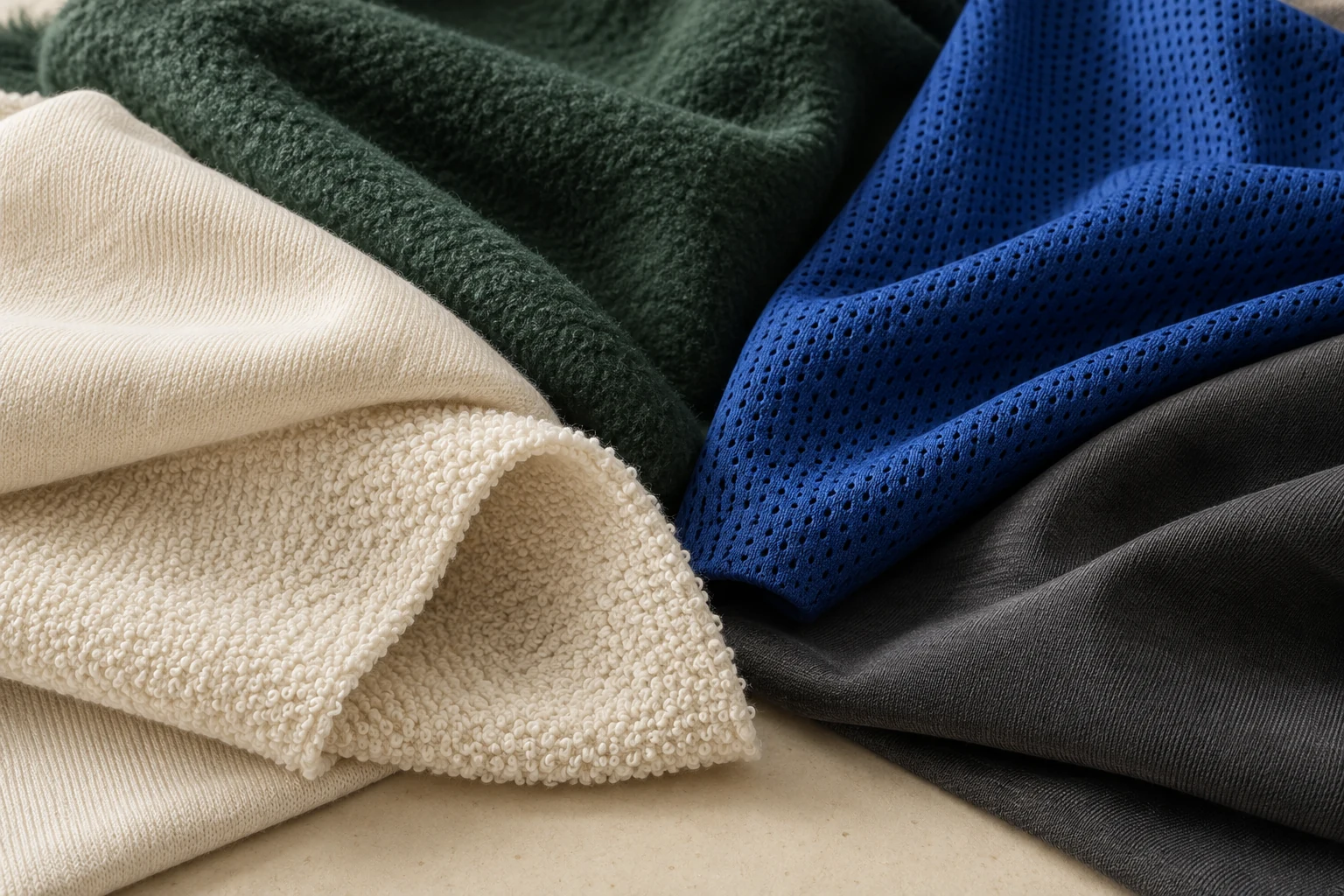
START WITH THREE THINGS
Ask for the fibre, the construction and the finished weight. Then judge the real swatch in your garment—not just a number on a screen.
What is it made from? Cotton, polyester, nylon and elastane are fibres. A blend states how much of each is present.
Example: 88% polyester / 12% elastane
How is it built? Jersey, interlock, rib, mesh and woven structures change the surface, movement and way the fabric behaves.
Example: a smooth stretch tricot
GSM is grams per square metre. It measures fabric mass per area. Brushing, dyeing and other finishes add another part of the decision.
Example: 220 GSM, sample to approve
WEIGHT DOES NOT EQUAL QUALITY
Compare weight within a fabric family. The same GSM can feel different in a mesh, a dense jersey or a brushed fleece.
A useful number to compare—but always assess the actual composition, construction and drape.
THE FABRIC LIBRARY
Explore construction, composition and weight, then shortlist fabrics for a conversation with our team.
Reference examples, not a stock list. The numbers below are researched educational specifications. Your Crownseam fabric, exact GSM, composition and availability are confirmed in your quote and approved sample. All fabric images are AI illustrations.
72 fabric references
sportswear Reference example
Football, running tops and training jerseys
Feel. Fine textured face with small eyelets.
Choosing it. Start here when you want a textured sports jersey. Compare the actual swatch against a smoother interlock.
Decoration. Sublimation on a suitable light polyester base; test transfers on the exact fabric.
Sample check. Check opacity when stretched, snagging, seam comfort and any specified wicking finish.
Educational specification; confirm your actual Crownseam fabric in your quote. Published reference ↗
sportswear Reference example
Match jerseys, shorts and teamwear
Feel. Smooth double-knit surface.
Choosing it. Compare with mesh when a smoother design surface matters. Interlock describes a construction, not a fibre.
Decoration. Sublimation where the polyester base is suitable. Review names and sponsor marks on the sample.
Sample check. Confirm finished GSM, opacity, stretch and the actual print result.
Educational specification; confirm your actual Crownseam fabric in your quote. Published reference ↗
sportswear Reference example
Basketball panels, practice layers and ventilation panels
Feel. A visibly open mesh structure.
Choosing it. Use an open surface intentionally: fine lettering can lose definition over larger holes.
Decoration. Test sublimation or a compatible decoration on the exact mesh.
Sample check. Check panel placement, coverage and print legibility; mesh alone does not prove moisture management.
Educational specification; confirm your actual Crownseam fabric in your quote. Published reference ↗
outerwear Reference example
Tracksuit jackets and trousers
Feel. Smooth face with a characteristic tricot structure.
Choosing it. Discuss the face, reverse and desired lining separately. A tracksuit can also be made from woven fabric.
Decoration. Choose decoration after testing the surface and heat response.
Sample check. Confirm seam stretch, lining, pocket construction and the finished fabric weight.
Educational specification; confirm your actual Crownseam fabric in your quote. Published reference ↗
streetwear Reference example
Everyday tees and relaxed brand basics
Feel. A fine knit with distinct face and reverse.
Choosing it. A useful starting point for a cotton tee. Assess the drape together with the fit and yarn.
Decoration. Discuss screen print, embroidery or a tested transfer. Standard polyester sublimation is not the cotton route.
Sample check. Approve dimensions after washing, twisting, opacity and neck shape on your sample.
Educational specification; confirm your actual Crownseam fabric in your quote. Published reference ↗
streetwear Reference example
Boxy tees and substantial streetwear shapes
Feel. A heavier jersey reference, with more material per area.
Choosing it. Pair the weight with the intended silhouette. More GSM is not a quality certificate.
Decoration. Screen print, embroidery and suitable raised effects after artwork and sample review.
Sample check. Check comfort, drape, neckline support and how a large print changes the feel.
Educational specification; confirm your actual Crownseam fabric in your quote. Published reference ↗
fleece Reference example
Hoodies, sweatshorts and matching sets
Feel. A smooth face with visible loops on the reverse.
Choosing it. Compare its looped interior with brushed fleece before choosing a sweatshirt fabric.
Decoration. Discuss screen print, embroidery, chenille or puff; approve decoration and wash together.
Sample check. Check the reverse, rib match, post-wash measurements and how the loops feel against skin.
Educational specification; confirm your actual Crownseam fabric in your quote. Published reference ↗
fleece Reference example
Hoodies, sweats and joggers
Feel. A brushed, softly raised inner surface.
Choosing it. Specify sweatshirt fleece clearly; it is a different fabric family from polyester polar fleece.
Decoration. Screen print, embroidery or other approved decoration on a suitable face.
Sample check. Approve the face composition, interior finish, pilling assessment and measurements after washing.
Educational specification; confirm your actual Crownseam fabric in your quote. Published reference ↗
trims Reference example
Necks, cuffs and waistbands
Feel. Vertical ribs with stretch across the structure.
Choosing it. Choose rib with the body fabric. Matching colour does not automatically mean matching recovery.
Decoration. Small decoration requires review; stretching rib can distort larger marks.
Sample check. Check recovery, finished opening size and the colour match after the same wash.
Educational specification; confirm your actual Crownseam fabric in your quote. Published reference ↗
streetwear Reference example
Polos and team presentation wear
Feel. A small raised, textured knit surface.
Choosing it. Compare piqué with jersey for the look of a polo. Ask for the actual fibre content rather than relying on its name.
Decoration. Small embroidery is a possible route; test fine detail against the surface texture.
Sample check. Check collar support, surface texture and logo placement on the sample.
Educational specification; confirm your actual Crownseam fabric in your quote. Published reference ↗
sportswear Reference example
Close-fitting training and performance garments
Feel. A smooth stretch construction.
Choosing it. Specify stretch direction and recovery as well as the fibre percentage. Confirm fit through movement.
Decoration. Review print stretch, heat response and coverage on the finished sample.
Sample check. Check opacity under tension, recovery, movement and whether decoration restricts stretch.
Educational specification; confirm your actual Crownseam fabric in your quote. Published reference ↗
outerwear Reference example
Movement-led trousers, shorts and outer layers
Feel. A fine woven surface with added stretch.
Choosing it. Discuss this route when a woven trouser or short is the aim. Polyamide is also known as nylon.
Decoration. Use decoration suitable for the exact nylon surface and finish; test adhesion and heat.
Sample check. Confirm surface finish, stretch direction, pocket support and garment movement.
Educational specification; confirm your actual Crownseam fabric in your quote. Published reference ↗
outerwear Reference example
Team jackets and outer layers
Feel. A broad category of functional stretch fabrics.
Choosing it. Request the full construction: face, backing and any membrane. Softshell is not a single fibre or fixed weight.
Decoration. Review embroidery or transfers with the layer structure and any surface treatment.
Sample check. Specify required performance and request supporting test information. The name alone does not establish waterproofness.
Educational specification; confirm your actual Crownseam fabric in your quote. Published reference ↗
streetwear Reference example
Smooth tees and substantial cotton basics
Feel. A smooth cotton double knit.
Choosing it. Compare with single jersey for surface, body and drape. Cotton and polyester interlock share a construction name, not a composition.
Decoration. Discuss screen print or embroidery; choose after reviewing the face and the artwork.
Sample check. Approve post-wash dimensions, softness and the neckline with the chosen trim.
Educational specification; confirm your actual Crownseam fabric in your quote. Published reference ↗
sportswear Reference example
Light sports tops and ventilated panels
Feel. Small openings and a fine textured face.
Choosing it. Ask for the actual mesh code and opening size. Micro describes a fine surface, not a guaranteed performance finish.
Decoration. Discuss sublimation on a suitable polyester base; test small lettering.
Sample check. Opacity, opening size, print detail and any required moisture-management test.
Educational specification; confirm your actual Crownseam fabric in your quote. Published reference ↗
sportswear Reference example
Jerseys, sports polos and training tops
Feel. A small cellular surface pattern.
Choosing it. Compare the texture with smooth interlock before choosing a large sponsor graphic.
Decoration. Sublimation may suit the right polyester base; review the textured print result.
Sample check. Surface pattern, coverage and the actual finishing specification.
Educational specification; confirm your actual Crownseam fabric in your quote. Published reference ↗
sportswear Reference example
Patterned jerseys and sports tops
Feel. A pattern built into the knitting.
Choosing it. A jacquard is a construction family. Ask for a swatch of the exact repeat and the reverse.
Decoration. Review print visibility over the knitted pattern.
Sample check. Repeat size, reverse floats, finished GSM and print contrast.
Educational specification; confirm your actual Crownseam fabric in your quote. Published reference ↗
sportswear Reference example
Light sports shirts and training shorts
Feel. A fine, relatively smooth jersey surface.
Choosing it. Start with coverage and fit rather than assuming every polyester jersey feels the same.
Decoration. Review sublimation on a suitable base; assess fine details at the actual scale.
Sample check. Opacity, stretch, drape and the approved colour.
Educational specification; confirm your actual Crownseam fabric in your quote. Published reference ↗
sportswear Reference example
Shiny teamwear panels and jerseys
Feel. A deliberate sheen on a knitted surface.
Choosing it. Approve the sheen under several lighting conditions; a photograph can exaggerate it.
Decoration. Assess sublimation or compatible marks on the precise surface.
Sample check. Surface shine, snagging, GSM and whether the sheen changes with stretch.
Educational specification; confirm your actual Crownseam fabric in your quote. Published reference ↗
sportswear Reference example
Rugby-style jerseys and substantial sports panels
Feel. A more substantial interlock reference.
Choosing it. Evaluate the weight with the actual cut and movement needed for the sport.
Decoration. Review sublimation and reinforced panel construction together.
Sample check. Seam comfort, movement, opacity and finished fabric weight.
Educational specification; confirm your actual Crownseam fabric in your quote. Published reference ↗
sportswear Reference example
Fitted tops, leggings and stretch sportswear
Feel. A smooth face with added elastic movement.
Choosing it. Confirm stretch in both directions. Elastane percentage does not establish a compression rating.
Decoration. Use a print route that remains compatible with the intended stretch.
Sample check. Recovery, stretched opacity, heat response and movement.
Educational specification; confirm your actual Crownseam fabric in your quote. Published reference ↗
sportswear Reference example
Leggings, fitted training tops and base layers
Feel. A fine stretch-knit surface.
Choosing it. Nylon is also called polyamide. Confirm the fibre blend and how the garment recovers after movement.
Decoration. Discuss nylon-compatible transfers or other tested decoration; standard polyester sublimation is not the default.
Sample check. Stretch, recovery, opacity and adhesion on the actual finish.
Educational specification; confirm your actual Crownseam fabric in your quote. Published reference ↗
sportswear Reference example
Stretch panels and layered performance designs
Feel. A fine open net with elastic movement.
Choosing it. Use it intentionally for coverage and support. Power mesh is not a medical compression specification.
Decoration. Avoid assuming large decorations can stretch with the net.
Sample check. Opening size, stretch direction, recovery and wearer coverage.
Educational specification; confirm your actual Crownseam fabric in your quote. Published reference ↗
sportswear Reference example
Performance swimwear development
Feel. A compact stretch fabric route for swim projects.
Choosing it. Ask for the exact blend and test requirements. A PBT description is not evidence of a chlorine-life claim.
Decoration. Discuss swim-compatible sublimation or decoration for the chosen grade.
Sample check. Wet fit, opacity, recovery and documented swim-use testing.
Educational specification; confirm your actual Crownseam fabric in your quote. Published reference ↗
sportswear Reference example
Fitted training and close-contact sports garments
Feel. A smooth, closely knitted surface.
Choosing it. Agree the intended fit. Do not equate a fabric trade name with measured compression.
Decoration. Test the artwork at the intended extension and position.
Sample check. Movement, recovery, stretched opacity and seam comfort.
Educational specification; confirm your actual Crownseam fabric in your quote. Published reference ↗
sportswear Reference example
Heather-look sports tops and tracksuits
Feel. Often used for a two-tone or heather effect.
Choosing it. CDP describes a yarn/dye route. Specify the actual construction and whether elastane is included.
Decoration. Approve the exact printing and dyeing route before relying on a colour effect.
Sample check. Fibre content, heather direction, colour and print sample.
Educational specification; confirm your actual Crownseam fabric in your quote. Published reference ↗
outerwear Reference example
Sports tops and tracksuit enquiries
Feel. The name alone does not define the surface.
Choosing it. Sialkot catalogues use light and heavy grades under this name. Ask for a physical swatch, code, fibre content and weight.
Decoration. Choose the decoration only after identifying the fabric.
Sample check. Do not infer swimwear suitability, fibre or performance from this trade name.
Educational specification; confirm your actual Crownseam fabric in your quote. Published reference ↗
streetwear Reference example
Stretch tees and fitted cotton basics
Feel. Cotton jersey with an elastic component.
Choosing it. Consider it when a fitted cotton garment needs more recovery than the chosen plain jersey.
Decoration. Screen print or transfers must suit the stretch and face.
Sample check. Stretch direction, neck recovery and measurements after care.
Educational specification; confirm your actual Crownseam fabric in your quote. Published reference ↗
streetwear Reference example
Textured tees and relaxed streetwear
Feel. Deliberately uneven yarn creates surface character.
Choosing it. Distinguish the planned slub texture from a production fault. Approve the actual yarn effect.
Decoration. Review fine type and ink coverage over the irregular surface.
Sample check. Surface consistency, opacity and the agreed texture.
Educational specification; confirm your actual Crownseam fabric in your quote. Published reference ↗
streetwear Reference example
Everyday tees, uniforms and brand basics
Feel. Handle changes with yarn and blend.
Choosing it. Ask for the exact cotton/polyester ratio; TC and CVC shorthand can vary between suppliers.
Decoration. Assess the ink system and any dye-migration risk for the selected blend.
Sample check. Composition, face yarn, colour and post-care dimensions.
Educational specification; confirm your actual Crownseam fabric in your quote. Published reference ↗
streetwear Reference example
Draped tees and softer fitted basics
Feel. A soft, fluid jersey reference.
Choosing it. Compare drape on the garment rather than assuming a soft swatch will hold a boxy shape.
Decoration. Test support for embroidery or a large print on the draping face.
Sample check. Drape, recovery, opacity and care behaviour.
Educational specification; confirm your actual Crownseam fabric in your quote. Published reference ↗
streetwear Reference example
Fluid tees and relaxed contemporary basics
Feel. A smooth fabric route with grade-dependent drape.
Choosing it. Lyocell is the fibre name. Branded fibres require supporting sourcing documentation.
Decoration. Review print, stabilisation and the intended drape together.
Sample check. Exact blend, surface finish and dimensions after care.
Educational specification; confirm your actual Crownseam fabric in your quote. Published reference ↗
streetwear Reference example
Textured or relaxed brand basics
Feel. Surface and drape depend on the yarn blend.
Choosing it. Request the exact blend and finish rather than treating hemp as a complete fabric specification.
Decoration. Review coverage on any irregular yarn texture.
Sample check. Hand-feel, twist, shrinkage assessment and fibre declaration.
Educational specification; confirm your actual Crownseam fabric in your quote. Published reference ↗
sportswear Reference example
Base layers and lifestyle layering
Feel. A wool-based jersey family.
Choosing it. Specify the actual wool blend and intended care route. The fibre name is not a warmth rating.
Decoration. Choose thread, support and decoration suitable for the actual knit.
Sample check. Handle, skin comfort, dimensions and the approved care assessment.
Educational specification; confirm your actual Crownseam fabric in your quote. Published reference ↗
streetwear Reference example
Textured tops and coordinated lounge sets
Feel. Raised cells and recessed channels.
Choosing it. Assess the depth and scale of the texture as well as weight.
Decoration. Large marks should be sampled over the texture.
Sample check. Cell definition, drape and post-care dimensions.
Educational specification; confirm your actual Crownseam fabric in your quote. Published reference ↗
streetwear Reference example
Draped tops and fitted lifestyle pieces
Feel. A fluid, flexible knit reference.
Choosing it. Choose it for a drape brief rather than assuming it behaves like a dense cotton tee.
Decoration. Review stabilisation for stitching and large decoration.
Sample check. Opacity, recovery and how the garment hangs after care.
Educational specification; confirm your actual Crownseam fabric in your quote. Published reference ↗
fleece Reference example
Hoodies, joggers and sweatshorts
Feel. Loops on the inside with a knitted face.
Choosing it. Check both the loop yarn and face composition. A blend label alone does not show which fibre is on the surface.
Decoration. Review print and wash on the finished blend.
Sample check. Face yarn, loop texture, rib match and measurements.
Educational specification; confirm your actual Crownseam fabric in your quote. Published reference ↗
fleece Reference example
Substantial hoodies and sweat garments
Feel. A brushed inner surface in a cotton construction.
Choosing it. Compare with loopback and cotton-blend fleece at the sample stage.
Decoration. Approve the face, print and any wash together.
Sample check. Brushed pile, shedding assessment, rib and post-care dimensions.
Educational specification; confirm your actual Crownseam fabric in your quote. Published reference ↗
fleece Reference example
Training sweats and warm-up layers
Feel. Knitted face with a brushed inside.
Choosing it. Keep this distinct from cotton sweatshirt fleece and double-sided polar fleece.
Decoration. Check heat response and any dye migration for transfers; approve sublimation only on the correct base.
Sample check. Face, reverse, heat response and garment movement.
Educational specification; confirm your actual Crownseam fabric in your quote. Published reference ↗
fleece Reference example
Fleece jackets and seasonal layers
Feel. A raised, softly brushed surface.
Choosing it. Choose the pile and density for the layer you are making. Recycled content needs documentation.
Decoration. Embroidery or a tested patch may suit the pile; review backing.
Sample check. Pile, seam bulk and any agreed pilling or care assessment.
Educational specification; confirm your actual Crownseam fabric in your quote. Published reference ↗
fleece Reference example
Light fleece layers, neckwear and linings
Feel. A shorter, finer fleece-pile reference.
Choosing it. Compare the actual pile with polar fleece; the word micro is not a universal weight standard.
Decoration. Review stabilisation and the way marks sit over the pile.
Sample check. Pile height, seam bulk and heat sensitivity.
Educational specification; confirm your actual Crownseam fabric in your quote. Published reference ↗
fleece Reference example
Pile jackets, hoodies and warm linings
Feel. A curly, lamb-like or teddy surface.
Choosing it. Sherpa is a surface style, not proof of sheep wool. Ask for the exact pile and backing.
Decoration. Test patches or embroidery with the pile and backing.
Sample check. Pile direction, seam bulk, shedding and care.
Educational specification; confirm your actual Crownseam fabric in your quote. Published reference ↗
fleece Reference example
Soft-pile loungewear and lining projects
Feel. A fine, plush pile surface.
Choosing it. Compare with Sherpa: coral is generally a different pile appearance. Confirm it by swatch.
Decoration. Approve decoration with suitable support for the pile.
Sample check. Pile direction, drape and the intended care route.
Educational specification; confirm your actual Crownseam fabric in your quote. Published reference ↗
fleece Reference example
Structured athleisure and modern tracksuits
Feel. A structured face-to-face fabric reference.
Choosing it. Tech fleece is a commercial category, not a fixed fibre blend. Request a cross-section and full specification.
Decoration. Review transfers, small marks and heat response on the chosen face.
Sample check. Layer construction, stretch, seam bulk and the finished feel.
Educational specification; confirm your actual Crownseam fabric in your quote. Published reference ↗
fleece Reference example
Active layering tops and technical midlayers
Feel. A grid of raised pile with channels between.
Choosing it. Specify the grid size, pile and exact blend. Generic grid fleece is not automatically a branded performance textile.
Decoration. Review small marks and supporting material.
Sample check. Grid definition, recovery and the evidence behind any performance claim.
Educational specification; confirm your actual Crownseam fabric in your quote. Published reference ↗
fleece Reference example
Fitted fleece layers and movement-led garments
Feel. A stretch face with a raised reverse.
Choosing it. Agree the stretch directions and recovery. A branded textile name needs genuine-source documentation.
Decoration. Test stretch and heat compatibility of the planned mark.
Sample check. Recovery, opacity, pile and garment movement.
Educational specification; confirm your actual Crownseam fabric in your quote. Published reference ↗
fleece Reference example
Structured sweat sets and fashion silhouettes
Feel. Smooth faces with a more substantial body.
Choosing it. Scuba knit is not the same material as neoprene foam. Ask to see the cut edge and feel the fabric.
Decoration. Test the actual face for heat response and decoration.
Sample check. Drape, recovery, bulk at seams and care.
Educational specification; confirm your actual Crownseam fabric in your quote. Published reference ↗
fleece Reference example
Velour tracksuits and textured streetwear
Feel. A short pile with a directional sheen.
Choosing it. Confirm the pile direction and fibre blend. Velour and woven velvet are different construction routes.
Decoration. Test marks over the pile; assess crushing and direction.
Sample check. Pile shading, seam direction and care.
Educational specification; confirm your actual Crownseam fabric in your quote. Published reference ↗
streetwear Reference example
Structured trousers and modern separates
Feel. A smooth, structured stretch-knit route.
Choosing it. Use the full composition; Ponte is a construction family rather than a fibre.
Decoration. Choose decoration after checking the face and heat response.
Sample check. Drape, recovery and shape at knees and seat.
Educational specification; confirm your actual Crownseam fabric in your quote. Published reference ↗
outerwear Reference example
Tracksuits and warm-up garments
Feel. A tricot-style face; brushed grades also occur.
Choosing it. Specify face, back and finished weight. The supplier code matters more than the trade name alone.
Decoration. Review sublimation or other marks only on the confirmed grade.
Sample check. Actual construction, surface, lining and finished GSM.
Educational specification; confirm your actual Crownseam fabric in your quote. Published reference ↗
outerwear Reference example
Windbreakers and woven track trousers
Feel. A matte woven surface.
Choosing it. Taslon/Taslan describes a yarn or fabric route. It does not automatically mean waterproof.
Decoration. Ask for decoration compatible with the finish on the actual cloth.
Sample check. Coating, drape, heat response and any requested performance tests.
Educational specification; confirm your actual Crownseam fabric in your quote. Published reference ↗
outerwear Reference example
Track pants and lightweight jackets
Feel. A fine diagonal grain.
Choosing it. Micro refers to the fine yarn/surface. A peach finish is a separate treatment, not the fibre content.
Decoration. Test transfers or embroidery on the exact finish.
Sample check. Weave, surface treatment, colour and movement.
Educational specification; confirm your actual Crownseam fabric in your quote. Published reference ↗
outerwear Reference example
Light jackets, track layers and utility panels
Feel. A fine visible reinforcement grid.
Choosing it. Ask for the grid, yarn and coating. A ripstop name does not establish waterproofness or a tear rating.
Decoration. Review marks with the weave and surface finish.
Sample check. Grid, coating, seam behaviour and required test evidence.
Educational specification; confirm your actual Crownseam fabric in your quote. Published reference ↗
linings Reference example
Jacket linings and selected shell projects
Feel. A fine, often lustrous woven surface.
Choosing it. Distinguish yarn denier, thread-count shorthand and GSM. A 190T label is not a 190 GSM claim.
Decoration. Choose decoration and pressing conditions for the exact finish.
Sample check. Coating, seam slippage, heat response and full layer declaration.
Educational specification; confirm your actual Crownseam fabric in your quote. Published reference ↗
linings Reference example
Light shell and lining development
Feel. A light, fine woven face.
Choosing it. Check denier and finish alongside mass per area; the same family spans many grades.
Decoration. Use nylon-compatible processes after a sample test.
Sample check. Coating, colour, seam behaviour and heat response.
Educational specification; confirm your actual Crownseam fabric in your quote. Published reference ↗
outerwear Reference example
Streetwear jeans, jackets and utility sets
Feel. A yarn-colour and twill surface with grade-dependent weight.
Choosing it. Approve the finished wash and fit, then record the exact weight and blend. Do not convert a trade weight casually.
Decoration. Review embroidery, patches or print with the finished wash.
Sample check. Shade, post-wash measurements, hardware and acceptable variation.
Educational specification; confirm your actual Crownseam fabric in your quote. Published reference ↗
outerwear Reference example
Cargo trousers, shorts, caps and utility pieces
Feel. A visible diagonal weave.
Choosing it. Choose the yarn blend, weight and finish for the garment rather than just ordering twill.
Decoration. Embroidery, print or transfer requires an exact-fabric test.
Sample check. Drape, seam strength, colour and care.
Educational specification; confirm your actual Crownseam fabric in your quote. Published reference ↗
outerwear Reference example
Utility jackets, workwear-inspired pieces and caps
Feel. A plain woven canvas construction.
Choosing it. Specify the intended drape and finished weight; a stiff canvas and a soft garment canvas behave differently.
Decoration. Review large prints, patches or embroidery on the chosen surface.
Sample check. Weight, seam bulk, wash result and hardware support.
Educational specification; confirm your actual Crownseam fabric in your quote. Published reference ↗
streetwear Reference example
Textured trousers, overshirts and caps
Feel. Parallel raised cords.
Choosing it. Specify the wale count and pile direction along with weight. These change the look of the garment.
Decoration. Review embroidery or patches across the ribs.
Sample check. Pile direction, rib definition and the approved care route.
Educational specification; confirm your actual Crownseam fabric in your quote. Published reference ↗
streetwear Reference example
Overshirts, shirts and lightweight woven pieces
Feel. A fine, relatively even woven surface.
Choosing it. Poplin is woven, unlike jersey. Decide whether a crisp or washed drape is the goal.
Decoration. Test print or small embroidery with suitable support.
Sample check. Opacity, crease behaviour, seam appearance and finished fit.
Educational specification; confirm your actual Crownseam fabric in your quote. Published reference ↗
outerwear Reference example
Varsity-style bodies and structured outerwear
Feel. A dense, felted-looking surface.
Choosing it. Separate genuine wool-blend melton from synthetic wool-look cloth. Confirm the full declaration and weight.
Decoration. Review appliqué, chenille or embroidery with the backing.
Sample check. Composition, structure, seam bulk and the care method.
Educational specification; confirm your actual Crownseam fabric in your quote. Published reference ↗
linings Reference example
Garment linings and ventilation panels
Feel. A fine open lining surface.
Choosing it. 5P is a supplier-grade description. Request the actual code and swatch rather than assuming a universal pore count.
Decoration. Usually a supporting layer; assess any visible branding separately.
Sample check. Opening size, transparency, seams and comfort.
Educational specification; confirm your actual Crownseam fabric in your quote. Published reference ↗
linings Reference example
Teamwear linings and ventilated panels
Feel. An open knitted lining construction.
Choosing it. Compare the actual 11P sample with the 5P sample. Local naming is not a technical standard.
Decoration. Keep outer decoration compatible with the full layered garment.
Sample check. Net opening, snagging, seam bulk and comfort.
Educational specification; confirm your actual Crownseam fabric in your quote. Published reference ↗
linings Reference example
Lining, padding panels and structured mesh applications
Feel. An open face with depth between textile layers.
Choosing it. Bubble can mean different things locally. Confirm whether you mean spacer mesh or padded quilted lining using a photo.
Decoration. Review any mark on the exact face and thickness.
Sample check. Thickness, recovery, layer construction and intended garment coverage.
Educational specification; confirm your actual Crownseam fabric in your quote. Published reference ↗
linings Reference example
Padded jackets and seasonal layers
Feel. A stitched surface enclosing padding.
Choosing it. Ask for total GSM and filling weight separately; they are not interchangeable numbers.
Decoration. Confirm decoration sequence so quilting and artwork align.
Sample check. Filling, stitch pattern, migration and final layer composition.
Educational specification; confirm your actual Crownseam fabric in your quote. Published reference ↗
linings Reference example
Varsity jackets and selected outerwear
Feel. A smooth face with visible sheen.
Choosing it. Satin describes the weave, not silk content. Confirm fibre, weight and surface feel.
Decoration. Review labels and any visible marks with heat sensitivity in mind.
Sample check. Seam slippage, snagging, colour and surface finish.
Educational specification; confirm your actual Crownseam fabric in your quote. Published reference ↗
linings Reference example
Lined sportswear and outer layers
Feel. A fine tricot face and brushed reverse.
Choosing it. Assess the inside finish and the final garment layer combination.
Decoration. Plan decoration on the correct outer face.
Sample check. Pile, heat response, seam bulk and comfort.
Educational specification; confirm your actual Crownseam fabric in your quote. Published reference ↗
linings Reference example
Jacket linings and selected lightweight shells
Feel. A fine, relatively matte woven surface.
Choosing it. A lining grade and a coated shell grade need different specifications. Ask for both weight and finish.
Decoration. Review heat and surface compatibility before decoration.
Sample check. Coating, density, seam behaviour and layer declaration.
Educational specification; confirm your actual Crownseam fabric in your quote. Published reference ↗
trims Reference example
Cuffs, waistbands, collars and rib garments
Feel. A more pronounced rib grouping than many fine 1×1 trims.
Choosing it. Approve rib with the body cloth; shade and recovery can differ even when the fibre blend matches.
Decoration. Review decoration under stretch if it is placed on rib.
Sample check. Recovery, opening size, shade and care.
Educational specification; confirm your actual Crownseam fabric in your quote. Published reference ↗
trims Reference example
Polo collars, cuffs and finishing components
Feel. A shaped knitted component with a finished edge.
Choosing it. Specify finished dimensions, yarn, stripe layout and the body fabric it must match.
Decoration. Review any branding on the actual component.
Sample check. Dimensions, curl, recovery and colour match after care.
Educational specification; confirm your actual Crownseam fabric in your quote. Published reference ↗
trims Reference example
Visibility accents and design details
Feel. A surface designed to reflect incident light.
Choosing it. Treat a reflective design accent separately from certified safety apparel. Request the required test evidence.
Decoration. Confirm sewing or transfer application for the chosen product.
Sample check. Reflectivity requirements, application, wash assessment and backing.
Educational specification; confirm your actual Crownseam fabric in your quote. Published reference ↗
trims Reference example
Specialist padded or structured accessories
Feel. A foam layer between textile faces.
Choosing it. This is different from scuba knit. Ask for the actual foam chemistry, thickness and intended application.
Decoration. Discuss marks with the foam and face fabrics as one system.
Sample check. Thickness, flexibility, bonding, skin-contact requirements and application suitability.
Educational specification; confirm your actual Crownseam fabric in your quote. Published reference ↗
Try a broader word, or ask us about your fabric.
Send the name, a reference photo, composition or desired GSM. We’ll help you discuss a suitable sourcing route.
Looking for a fabric not shown? Share the composition, weight or a reference garment with us. We’ll discuss what can be developed for your order.
FIBRES, FABRIC FAMILIES & LOCAL NAMES
A familiar supplier name is a starting point. The swatch code, fibre percentages, construction, GSM and finish make the specification.
Spandex and elastane name the same generic stretch fibre. LYCRA is a brand of fibre. It is blended into fabrics; a stretch jersey is not automatically genuine branded LYCRA.
Fibre manufacturer reference ↗Local catalogues use commercial names and grade codes. Request the exact sample: these names do not establish a universal GSM, composition, certification or end-use performance.
Ask to see the cut edge and layers. A double knit, a bonded textile and foam laminate are different constructions. Their complete composition and weight need separate descriptions.
Clarify the reference with a photo. You may mean a 3D spacer mesh or a quilted padded lining. Ask for thickness, total GSM and any filling weight separately.
These are fibre choices; jersey and terry are constructions. Organic or recycled content needs supporting documentation. A fibre name alone does not prove a sustainability claim.
Lyocell fibre reference ↗These measures describe different things. GSM is fabric mass per area, denier describes yarn linear density, T is used in construction-count descriptions, and millimetres describe thickness. Ask for the actual data rather than converting one into another.
Public Sialkot and Pakistan catalogues list a wide range of meshes, knits, fleeces, tracksuit fabrics and linings. Tell Crownseam the construction and finish you want; we’ll discuss a sourcing route and confirm the exact grade before ordering.
Request a sourcing check →FROM FIBRE TO FINISHED GARMENT
This is the general textile journey. The actual route depends on the material and design; fabric suppliers and garment manufacturers may handle different stages.
Choose the fibre blend and yarn to support the intended fabric.
Build the structure: loops for knits, interlaced yarns for wovens.
Dye, heat-set or finish as appropriate to the chosen material.
Plan panels, artwork and the correct decoration sequence.
Assemble, inspect and review the finished sample before approval.
PRINTING & DECORATION
Start with the design, then choose a method that suits its material, detail, position and intended feel. Approve the result on the real fabric.
01 / Colour within the fabric
Suitable polyester base
All-over sports artwork and gradients.
Approve: Base colour, polyester content, print placement and seam alignment.
02 / A printed surface
Compatible cotton and blend faces
Bold artwork, type and defined colour separations.
Approve: Ink system, colour separations, print hand-feel and curing.
03 / Artwork transferred to fabric
Exact fabric and finish must be tested
Names, logos and detailed marks.
Approve: Heat tolerance, adhesion, dye migration and stretch.
04 / Stitched thread texture
Stable area with suitable support
Crests, small chest branding and textured marks.
Approve: Digitising, backing, stitch density and puckering.
05 / Raised printed relief
Compatible face and ink system
Dimensional streetwear lettering and shapes.
Approve: Expansion, fine-detail limits, curing and the finished wash sequence.
06 / A sewn or attached patch
Garment and patch to approve together
Varsity letters and layered branding.
Approve: Patch size, edge stitching, backing and attachment.
Technical reading: Epson: sublimation substrates ↗ · Epson: DTF film printing guide ↗
WASHES, DYES & SURFACE FINISHES
Colour, texture and variation should be intentional. Use a real finish reference and approve the full garment.
A wash can affect a printed mark, thread, rib and measurements. Ask whether the finish happens before or after decoration, and approve the combined result.
Colour applied after assembly.
Discuss before sampling: Check body, sewing thread and trims together; different components may take colour differently.
A surface-colour route with a distinctive aged character.
Discuss before sampling: Agree the exact process and shade reference, then review rubbing and wash behaviour.
Different routes to an irregular, worn-in appearance.
Discuss before sampling: Use an approved physical finish reference. These names are not interchangeable recipes.
A deliberately faded visual direction.
Discuss before sampling: Agree where fading appears and what variation is acceptable across the order.
A finishing route that changes the surface or handle.
Discuss before sampling: Confirm the actual process, compatible fibre and final hand-feel on a sample.
A deliberately variable pattern and colour effect.
Discuss before sampling: Approve the colour family, placement direction and acceptable piece-to-piece variation.
PUT THE CHOICES TOGETHER
Walk through a team kit, a streetwear launch and a coordinated set. These are planning examples, not invented customer success stories.
WORKED EXAMPLE 01
A club wants clear sponsor artwork, comfortable movement and a consistent team look.
Explore the fabric →Illustrative planning brief. This is not a customer order or a tested production result.
Record the cut, player sizes, panel layout and front/back artwork.
Compare the textured birdseye reference with a smooth polyester interlock. Check opacity and comfort on the real swatch.
Discuss sublimation on the approved polyester base. Verify names, sponsor legibility and panel alignment.
Check movement, measurements and colour. Review the finished garment after the agreed care assessment.
Keep the approved specification, then review daily progress photos and any decisions requested by the factory.
Choose a sports construction for the actual activity; a mesh label alone does not prove performance.
WORKED EXAMPLE 02
A new label wants a substantial silhouette, a washed colour and a raised chest graphic.
Explore the fabric →Illustrative planning brief. This is not a customer order or a tested production result.
Record the silhouette, hood shape, pocket, rib, artwork and desired finish reference.
Compare French terry and brushed sweatshirt fleece by feel, weight and drape. Specify body and trims separately.
Review the wash and puff or embroidery together. Agree the production sequence before sampling.
Check the finished shade, graphic texture, rib match, fit and post-wash measurements as one complete garment.
Keep the approved finish reference. Agree acceptable variation and the photos or videos needed for your brand.
Approve the complete fabric, wash and decoration combination, rather than approving each effect separately.
WORKED EXAMPLE 03
A brand wants a matching jacket and trousers with piping and small embroidered branding.
Explore the fabric →Illustrative planning brief. This is not a customer order or a tested production result.
Record jacket and trouser fit, movement, pockets, lining, zip and piping positions.
Compare a knit tricot route with a suitable stretch woven. Decide whether the jacket and trousers share a fabric.
Review embroidery support and piping construction. Assess colour matching across body panels and trims.
Try the full set through movement. Check dimensions, seam comfort, logo size and the proposed care method.
Approve the full set as the reference, keep revision notes and request updates at each decision point.
Matching colours do not automatically mean matching fabrics or identical care requirements.
YOUR COLLECTION, WITH A CLEAR PROCESS
You should understand what’s being made and which decisions need you. Our team keeps you updated from sampling through production.
Your order allocation and schedule are confirmed separately in your quote.
Receive daily updates, photos and videos during sampling and production so you can follow the work.
When a stage needs your decision, we request your approval before proceeding with that decision. Keep changes and approvals in writing.
Production photos and videos can support your own social media. Agree the shots, format, branding, permissions and any editing requirements with us.
CARE & AFTERCARE
Care belongs in the product brief. The final instructions must suit the finished garment, including its dye, decoration and trims.
Read GINETEX care principles ↗Use the method approved for that exact product. A cotton body and a raised print can have different limits; assess the complete combination.
Record the agreed wash assessment, measurements, colour and decoration appearance before final approval.
Agree the final wording and label artwork. Share the same care information with your customers.
QUESTIONS NEW BRANDS ASK
Start here. If your material, design or process needs a more specific answer, send us your brief.
Ask your own question ↗GSM means grams per square metre: the mass of a fabric over a standard area. It helps you compare weight, but it does not by itself measure quality, thickness, softness or performance. Compare the composition, construction, finish and sample as well.
Composition states the fibres in a fabric and their proportions, such as 100% cotton or 88% polyester and 12% elastane. Construction describes how those yarns are made into fabric. A name such as jersey or interlock is a construction, so always ask for both.
No. The labelled reference examples explain fabric families using published textile specifications. Confirm the exact Crownseam fabric, composition, finished GSM, colour and availability in your quote and approved sample. Images are AI-generated illustrations, not photographs of actual stock.
Start with the intended fit, coverage and artwork. Compare suitable polyester interlock with mesh, and check the print, stretch, seam comfort and opacity on a sample. Basketball may use a different panel structure and opening size from a football jersey. A fabric name alone does not prove breathability or wicking.
French terry has visible loops on the reverse; brushed sweatshirt fleece has a raised inner surface. Compare them at the weights and fibre blends you are considering. Choose by the intended hand-feel, climate, drape and sample rather than the name alone.
No. A heavier fabric can suit one silhouette and feel unsuitable for another. Yarn, construction, consistency, finishing, sewing, print compatibility and post-wash behaviour also matter. Choose the fabric for the garment and its wearer.
Standard dye sublimation is intended for suitable polyester fabrics or coated substrates, rather than ordinary untreated cotton. For a cotton tee, discuss screen printing, a suitable transfer or another compatible method. Approve a test on the exact fabric.
Sometimes, but the jacket, trousers, pocketing and trims may need different constructions. Check movement, recovery, colour matching and the approved finish across the complete set. Confirm which components share the same fabric in your specification.
Discuss the full combination before sampling. The base fibre, dye, wash process, print chemistry, thread and production sequence all affect the result. Approve the completed combination on a sample; separate swatches do not prove the combined result.
The general route runs from fibre and yarn to knitting or weaving, then dyeing and finishing, cutting, decoration and sewing in a sequence appropriate to the design. Some decoration is applied to panels and some to assembled garments. The agreed production plan determines the order.
Crownseam has manufacturing capacity of 2,000 pieces per week. Capacity is separate from your order schedule; confirm the production allocation and delivery plan for your specification in your quote.
Yes. Crownseam provides daily progress updates, photos and videos during sampling and production. When a step needs your decision, we request your approval before proceeding with that decision.
Yes. Crownseam can provide production photos and videos for your brand’s social media platforms. Agree the shots, format, branding, permissions and any editing requirements with us before production. Specific deliverables are confirmed with your order.
Review composition and GSM, fit and measurements, colour, movement, opacity, seams, trims, artwork size and placement, the decoration and any wash finish. Review care instructions and the agreed wash assessment. Record your approval and any required changes clearly.
Use instructions established for the finished garment, taking the fabric, dye, wash, print, trims and accessories into account. Follow its care label. Ask for the proposed care method and sample assessment before approving the final instructions; one temperature or drying method cannot suit every design.
Tell us the exact certification or recycled-content requirement before sampling. Ask for documentation covering the chosen fabric and order. An educational reference to a fibre or finish is not a Crownseam certification claim.
Mockups and sublimation file recreation are currently free. Sample, logo redraw and size-set costs are confirmed in your quote. Confirm the scope of any requested service with the team.
Email [email protected] with your garment, intended use, preferred feel, design, expected quantity and delivery destination. Include reference photos if you have them. We can discuss a suitable fabric and decoration route before you finalise the specification.
Spandex and elastane are names for the same generic stretch fibre. LYCRA is a brand of fibre, not a universal name for every stretch fabric. A fabric usually blends elastane with cotton, polyester, nylon or other fibres. Confirm the exact percentage and require documentation before describing the fibre as branded LYCRA.
Some Sialkot suppliers use this trade description for light and heavy fabric grades. It does not establish a universal composition, GSM or construction. Ask for the supplier code and a physical swatch. Do not infer swimwear suitability or any brand association from the local trade name.
No. Scuba is used for a dense double-knit textile; neoprene refers to a foam material that can be laminated to textile faces. Ask to see the cross-section and confirm whether the quoted weight is for a knit or a foam laminate. Choose according to the intended garment or accessory.
The name is used for different surfaces. It may mean 3D spacer or air mesh with depth between layers, or a padded quilted lining with a bubble-like appearance. Send a photo or swatch and confirm layer construction, thickness, total GSM and any filling weight separately.
Public Sialkot and Pakistan catalogues list many of these families, including meshes, interlocks, jersey, fleece, Trinda, softshell and linings. A catalogue listing does not confirm current stock or your exact grade. Crownseam can discuss sourcing against your specification; availability and the actual composition and weight are confirmed before ordering.
No. Cotton sweatshirt fleece, cotton-polyester sweatshirt fleece and polyester polar fleece are different material routes. Compare the face, reverse, fibre blend, pile, GSM and care assessment. Choose by the garment and approved sample rather than the word fleece alone.
No. Tech fleece is a commercial fabric category rather than a single standard blend. Different products can use different double-knit, bonded or raised-back structures. Request the exact layer construction, composition, finished GSM and stretch specification.
Use the contact button below the library or email [email protected]. Share a fabric name, composition, desired GSM, garment or reference photo. We will discuss whether a suitable sourcing or development route is available for your order.
YOU DON’T HAVE TO KNOW EVERY FABRIC NAME
Share the garment, how it will be worn and the look you’re aiming for. We’ll help you discuss a suitable material and decoration route.
[email protected] ↗Mockups and sublimation file recreation are currently free. Sample, logo redraw and size-set costs are confirmed in your quote.